

Radar detection by Yangjiang Nuclear Power Plant Water Supply Company
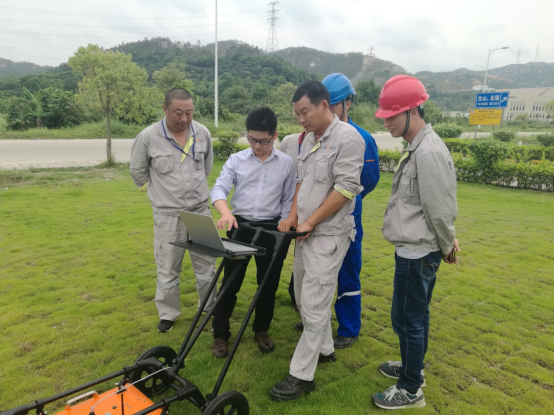
Summary: During this radar test, the site was mostly on grass, with both metal and non-metal tubes present. Due to radar testing, its essence is to test for anomalies in underground media and infer the location of pipelines based on the abnormal reactions. From the on-site testing, it can be seen that due to the large abnormal reaction of the metal tube, the test waveform is very clear. Compared to non-metallic pipelines, the abnormal reactions are relatively small, and in some places, it is difficult to determine. But overall, the positions and depths of all tested pipelines are reliable!
Product Details
Location: Yangjiang Nuclear Power Plant Water Supply Company
Weather: showers, north wind, level 3, temperature: 23 ℃ -29 ℃
Test site: On the grassland to the left of the water plant, the radar travels in the direction from the entrance to the left
The on-site measured data is as follows:
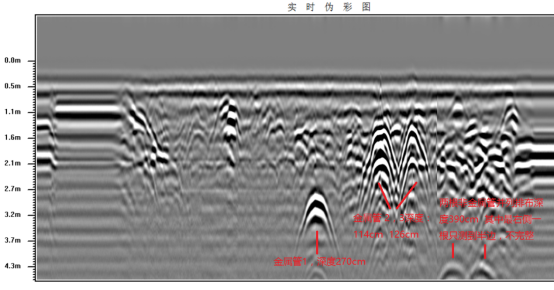
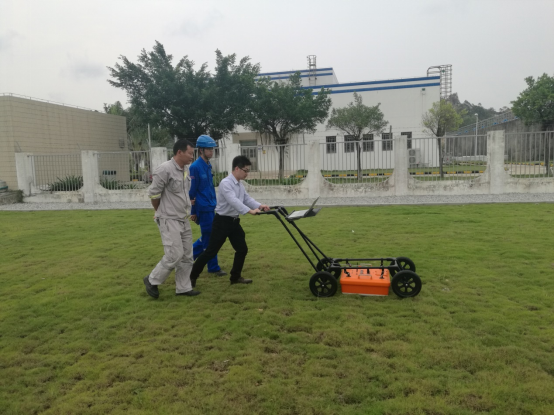
As shown in the figure, a total of 5 pipelines were tested, but the rightmost non-metallic pipeline was displayed incompletely,
The layout of the five pipelines from left to right is as follows:
1. Metal tube 1, buried at a depth of 270cm
2. Metal tube 2, buried at a depth of 114cm, metal tube 3, buried at a depth of 126cm, two are basically arranged together
3. Non metallic pipes 4 and 5 are arranged side by side with a burial depth of 390cm. However, during on-site testing, the rightmost pipe was not fully displayed.
The on-site measured data is as follows:
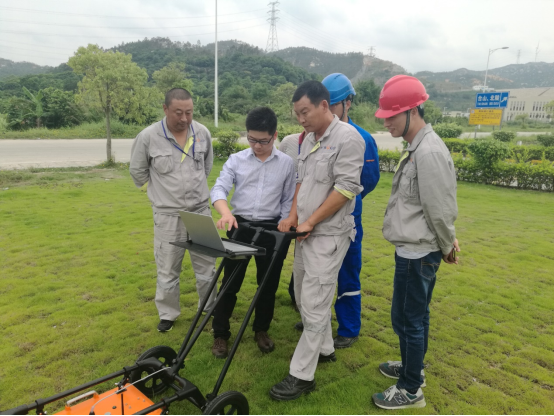
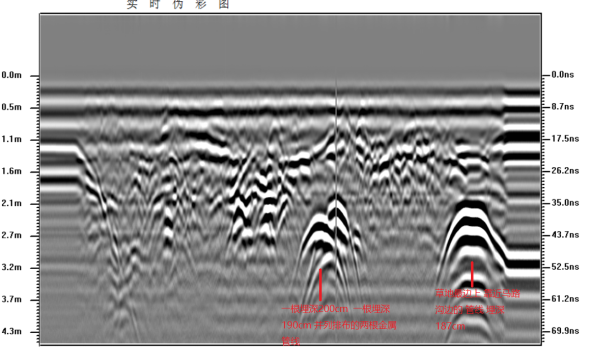
The on-site test data is shown in the above figure: the direction of this radar test is from the water plant gate to the road
Three pipelines are clearly visible:
1. A metal pipeline with a burial depth of 200cm and a burial depth of 190cm arranged in parallel, very close to each other.
2. A pipeline buried 187cm deep near the roadside ditch on the edge of the grassland